Origins of the Surname of Hope - Section 1
1. Derivation of the name.
The spelling of Hope had many variations in the older Scottish documents that were originally in Norman French or Latin. The following are examples – Hopes, Hop, Houppe, Houpe, Houp, Hoip, Houip, Hoppe and others. It should be noted that hoip was a recognised spelling of the word hope as buik was for the word book. Hopes and Hoppe still survive as separate surnames but certainly in Scotland they are few in number. The maps on the Surname Profiling site mentioned in the Hope Origins page indicate that the heartlands of the Hopes and Hoppe are not the same as Hope and that the name Hoppe is imported from Hungary/Polond! Another surname that one might think was a variation of Hope is the name of Shope which with its variations of spelling actually originates in Belguim.
Possible confusion between the plural of the name Hope- Hopes and the name Hopes is obvious - both appear on this website.
What would appear to be a different but similar surname appears in the records as Hepe which survives to the present as Heap or Heaps.
On the Hope Origins section a selection of derivations of the origin of the word hope from the Oxford English Dictionary is listed - the requirement for surnames came about in Scotland c1100. The following is an enhancement of that list. It is fairly certain that the origin of the Scottish Borders surname is as indicated below under section a):-
a) From Middle English - an enclosed valley, a hollow among the hills. The peoples of the Kingdom of Northumbria, an area that included what is now the Scottish Borders, applied the name to the very distinctive side valleys of the tributaries of the River Tweed and to the tributaries of the River Tyne in Northumbria/Cumbria. This is the origin of the Scottish Borders surname. (Topographical features were important as boundary markers - more about this below). However it is evident that by the middle of the fourteenth century a hope was more than just a topographical feature but had become more like a farm, producing revenue - see the extract from the Calendar of Close Rolls for Tynedale page.
(Note - A Howe, also a Scottish surname, is also a topographical feature and is a depression, a hollow, glen,dell or a narrow piece of land. This northern Scottish word is of Anglo-Saxon origin)
b) From Old English – a piece of enclosed land e.g. in the midst of fens or marshes or waste land generally. This could certainly be one of the origins of the English surname. Recent research has revealed that there could be a connection between a hope and old lead mines. and the definition of waste land generally could cover this?
c) From Old Norse – a landlocked bay, a haven - very possible.
d) From Dutch – Hoop (Hope) meaning Esperance. Probable origin of the Hope family of Edinburgh. and Hope Family Heraldry.
e) From the word hops - as in brewing - possible but no evidence found so far.
From a) above New. A topographical feature such as a hope as an enclosed valley was important as a boundary marker. An inspection of boundaries, particulalry of common land to prevent encroachment from neighbouring landlords, was routine. The following from the Peebles records - The marches of Hamilton Hill were periodically visited by the town council and community. An account of one of these perambulations, on 7th June 1556 appears in the printed Records, and is described as a visitation, in accustomed form, of the marches between the lands of Kidstoun, Chapelhill, and Eddistoun, and the property of Hammiltoun belonging and pertaining to the baillies, community, and inhabitants. Begining at places called Burrelfield and Acomfield, (now Rosetta and neighbourhood), the march went up the syke to Jedburghfield, over the swyre and on to the syke in Eddistoun hoip, which it passed upwards, thence to Kidstoun hoip heid, which it passed downwards, and thence eastwards, north, and south-eastward, by march stones, cairns, bushes, and other land marks, till the starting point was regained. What is interesting is the number of topographical features that have become Scottish Surnames - March, Swyre (Swire), Syke (Sykes), Hoip (Hope), hope heid (Hopehead), Stone, Cairns and Bush! The custom of inspecting the boundaries is carried on to this day in the form of the Riding the Marches in several Scottish Border towns.
A list of the names of various scottish valley and waterway names in order of magnitude follow:-
Valleys - Cleuch, Hope, Glen, Valley and Dale. (Cleuchs & Hopes are closed at one end)
Waterways - Syke, Burn, Water, River and Firth(Estuary).
A small enclosed valley is a popular derivation of the surname and is particularly valid for the Scottish Borders area where in Roxburgh, Selkirkshire and Peeblesshire, particularly in the Ettrick Forest, there are many such valleys with a name including Hope as a suffix and in fewer cases as a prefix. The people living in these valleys must have taken the valley name as their surname. Examples of these valley names taken from around Tweedsmuir are Tweedhope, Priesthope, Carterhope, Kingledoreshope, Gameshope, Winterhope, Hopecarton, Stanhope, etc. A lot more about this later in the sections about the Border Hopes. It is worth mentioning that the word Hope as a topographical feature would have arrived in Scotland from England in the Anglo-Saxon period (c400-900) long before the advent if surnames in Scotland c1100. The feature that the residents of the Border area named a hope probably bore very little resemblance to the Anglo-Saxon feature of a hope in England.
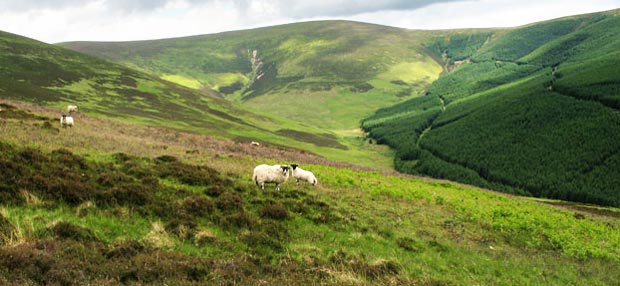
The head of Hopecarton showing the enclosed end. The hope is very narrow with a burn (stream) running through it providing watering facilities for the sheep. The hope widens as it merges with the valley of the River Tweed. There are comparatively few sheep now compared to the numbers that would have grazed over these hills when the monks of Melrose managed this area in the thirteenth/fourteenth century.
On the north coast of Scotland there is an area that was known as Hope that includes Loch and Ben Hope and the emonymous hamlet. A derivation from this area is possible as the Norse influence did spread southwards along the west coast as far as the Solway, the Isle of Man, Cumbria and Ireland. The influence also spread inland in Scotland through Ayrhire to Lanarkshire. The surname of Obrinkle appearing in the Ragman's Roll is interesting - See Section 3 Border Hopes. The Ob and Hob representing a haven in Norse does appear as a prefix in place names such as the west coast town of Oban.
The linking of Hope with a haven, either land based or maritime is valid. On the Firth of Forth just west of the bridges is a point known as St. Margaret’s Hope. This is where Margaret Atheling, future Queen of Scots and Saint, stepped ashore with her father Edgar Atheling a saxon claimant to the English throne. They were fleeing England by sea after the Norman invasion of 1066 and were blown off course. They had made a previous landfall in Northumbria and that site is known as St. Margaret’s Haven.
Another example of this, which coincidently is in the same area, is in Kidnapped a novel set in 1751 by Robert Louis Stevenson. “Just then we came to the top of the hill, and looked down on the ferry and the Hope. The Firth of Forth narrows at this point to the width of a good sized river, which makes a convenient ferry going north, and turns the upper reach into a land-locked haven, for all manner of ships.”
Twentieth century literary examples of a hope as an enclosed valley were penned by John Buchan (1875-1940). In his short story the Green Glen his description of the glen mentions the green hope at the head. Buchan also mentions the Border hopes several times in the context of the excellent fly fishing for trout in his his unfinished work about fishing titled Pilgrims Rest.
William Chambers in his History of Peeblesshire published in 1864 had the following to say about Hope - The resemblance between many words in Norwegian, Danish, and old Saxon, renders it difficult to assign a distinct origin to certain names. No affix is more common in Peeblesshire than Hope, as Soonhope, Gaithope, Waddenhope, etc. The meaning of the term is a valley among hills, closed at one end, a cul-de-sac: literally, it denotes a haven or place of refuge (Islandic, Hop), in which sense it is applied to various maritime resorts. Hope was formally used also as a prefix - for example, in Hopkailzie, the old name for Kailsie.
The emblem of a ship’s anchor is an emblem of hope as is the cross for faith and the heart for charity/love. The various Hope families have used the anchor to good effect in their canting heraldry - see section 9 Hope Heraldry. There are several pubs named the Hope & Anchor in England, Wales and overseas in USA, Canada etc but none in Scotland. At least one, in Wirksworth in Derbyshire, has the pub hanging sign showing the Hope lady with the anchor - see below. 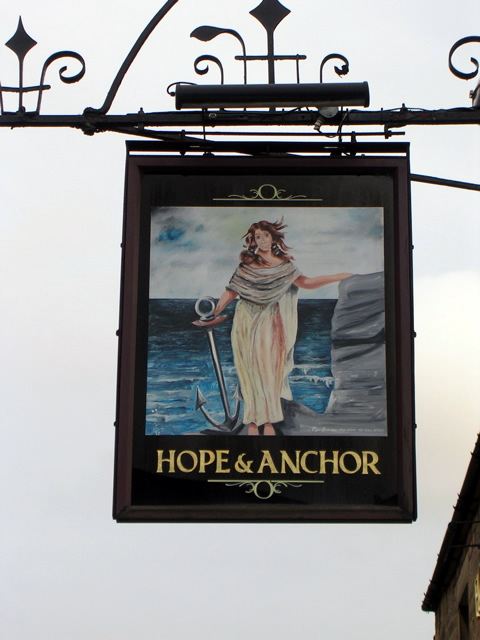
The spelling of the brewing hops was usually spelt hoip according to lists of charges in 1575 for the transporting of merchandise from the docks at Leith (Port for Edinburgh) to the warehouses.
It was also suggested by Nisbet that the French family of H'oublons of Picardy (oublon = Hops) were the origin of the surname - unlikely in my view.
At dysart in Fife there is the following ancient inscription above a doorway My hoip is in the Lord 1583. Whether the inscription is that old is doubtful. As mentioned above hoip was a recognised spelling of hope.
Hope meaning esperance a virtue of the mind is a wonderful possible derivation of the surname and the Hoops of Holland could be a source. The name survives in Holland principally as Van Der Hoop.
What unbalances the Hope name in Scotland is one particular family, namely the descendants of Sir Thomas Hope of Craighall Bt. (1573-1646) – Lord Advocate to Charles I. This family over the centuries has added a lustre to the name resulting in the Scottish Hopes punching well above their weight. A dramatic example of this is that in 1995 in the House of Lords there were seven peers with the surname of Hope. This is a record number of peers with the same surname being members of the House of Lords at the same time. Five of the seven peers were Scottish all being descendants of the above Sir Thomas Hope of Craighall! These five peers being Glendevon, Craighead, Linlithgow (Marquis), Rankeilor and Hope-Johnstone (Earl). The other two were English, one was the Rev. David Hope then Bishop of London subsequently Archbishop of York now Lord Hope of Thornes, Wakefield, West Yorkshire. The other is Hope-Morley, Baron Hollenden of Hall Place in Kent. It is believed that descendants of Sir Thomas settled in Lancashire - see the Lancashire section of the English Hope page.
___________________________________________________________________
or
or
Continue to Section 2.1 Scottish Borders Hope prior to 1296.
or Section 2.2 Scottish Borders Hope after 1296.
Continue to Section 3. Edinburgh Hopes